My House - A scoring API for prioritizing families in an affordable housing program, built with Hexagonal Architecture (Ports & Adapters)
"What goes inside the hexagon? I don't care." - Cockburn
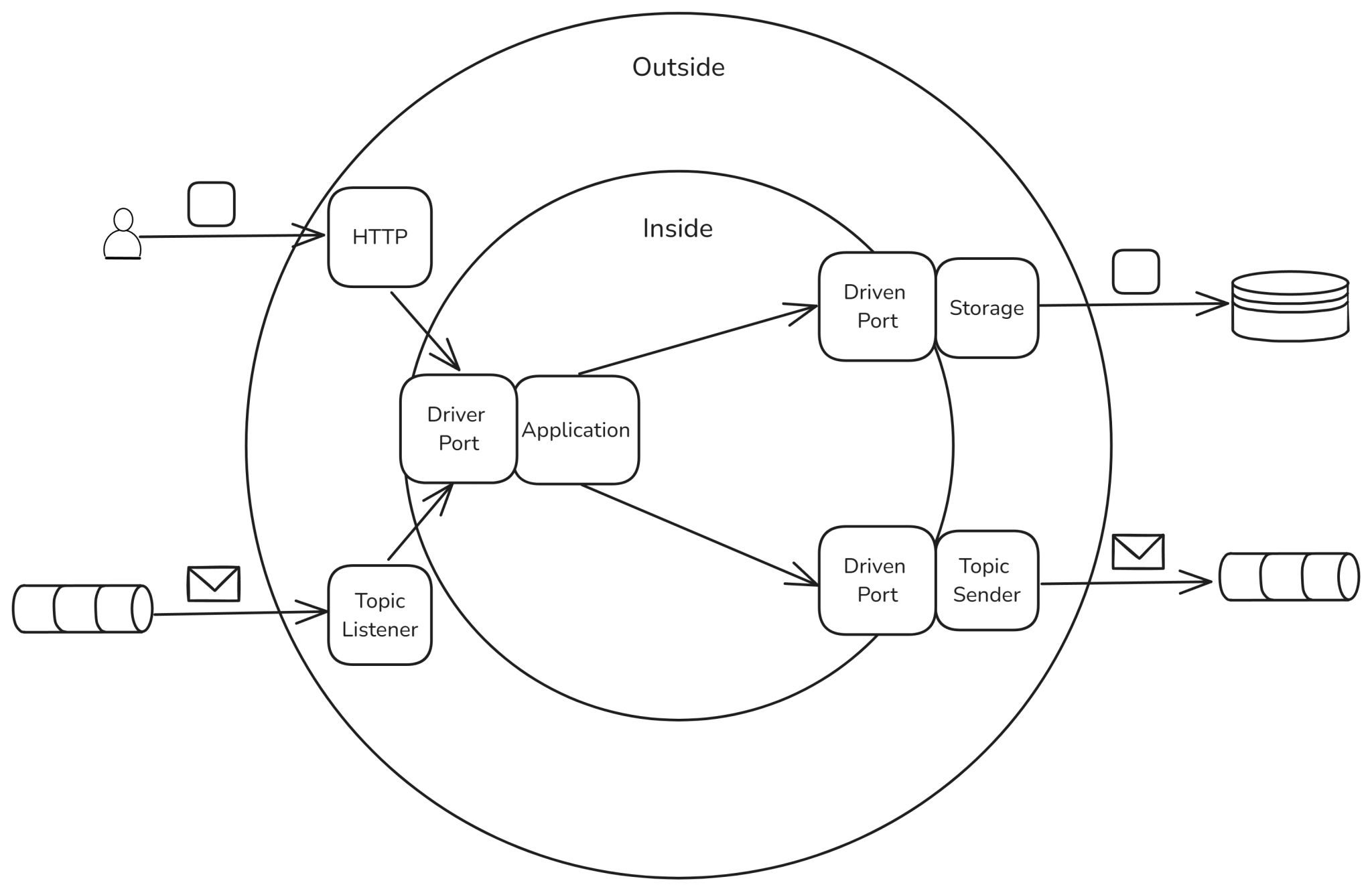
My House is a scoring API for prioritizing families in an affordable housing program: it takes a batch of families (total income and dependents), scores each one against business rules, and returns the eligible families sorted by score. The point isn't the CRUD itself. It's using a small domain with real rules to put Hexagonal Architecture (Ports & Adapters) into practice end to end, keeping the business core 100% independent of Spring.
The key idea of Hexagonal Architecture is the dependency rule: everything points inward. The
domain doesn't know Spring, HTTP, or a database exist; the edges are what know about the domain. The outside
world talks to it through ports (interfaces defined by the domain), which infrastructure
adapters implement. A POST /families comes in through an HTTP adapter, passes
through a use case, and reaches the core; on the way out, persistence goes through a port, never a direct
dependency. In practice, swapping in-memory for Postgres, or REST for messaging, only touches the edges, and the
core stays intact.
Design & Architecture Decisions
-
Framework-free domain: the entities (
Family,Dependent) and the scoring rules are plain Java, with no Spring annotations and no infrastructure dependencies. The framework stays at the edge. -
Ports & Adapters: the ports are gateway interfaces (
RegisterFamiliesGateway,ListFamiliesGateway) defined in the domain; persistence plugs in through adapters (in-memory for now) that can be swapped for a real database without touching the core. -
Strategy for eligibility rules: scoring is abstracted behind the
Scoringinterface, implemented byMyPopularHouseScoring. Changing the program's criteria means plugging in another strategy, without touching use cases or entities. -
Explicit use cases: each operation is a use case with its own Input/Output under a shared
contract (
UseCaseContract<I, O>):RegisterFamiliesandListEligibleFamilies. - Manual IoC: dependencies are wired in dedicated providers, making it clear what assembles what and reinforcing that the domain doesn't know about the container.
-
Builder for queries: pagination and sorting go through a
Filterbuilt with a Builder (sortBy,pageNumber,pageSize). -
Factory methods on the entity:
Family.create()(new family, score calculated on construction) andFamily.restore()(rehydration), preventing invalid states.
The rules themselves (income brackets, per-dependent bonus) are just what goes inside the hexagon,
deliberately simple and swappable via Strategy. What matters here is that they live in the domain,
with zero coupling to Spring, HTTP, or persistence.
REST API
POST /families: registers a batch of families with income and dependents.GET /families/eligibles: lists eligible families sorted by score (paginated).
Quality & Testing
- Unit tests on the core (the
Familyentity and the scoring strategy), without booting Spring. - Domain testable in isolation, a direct result of keeping business rules separate from infrastructure.
Stack
- Java 17
- Spring Boot (only at the edge: HTTP controllers and bootstrap)
- Maven
- Docker